Best Digital Signage Video Formats for Reliable Playback
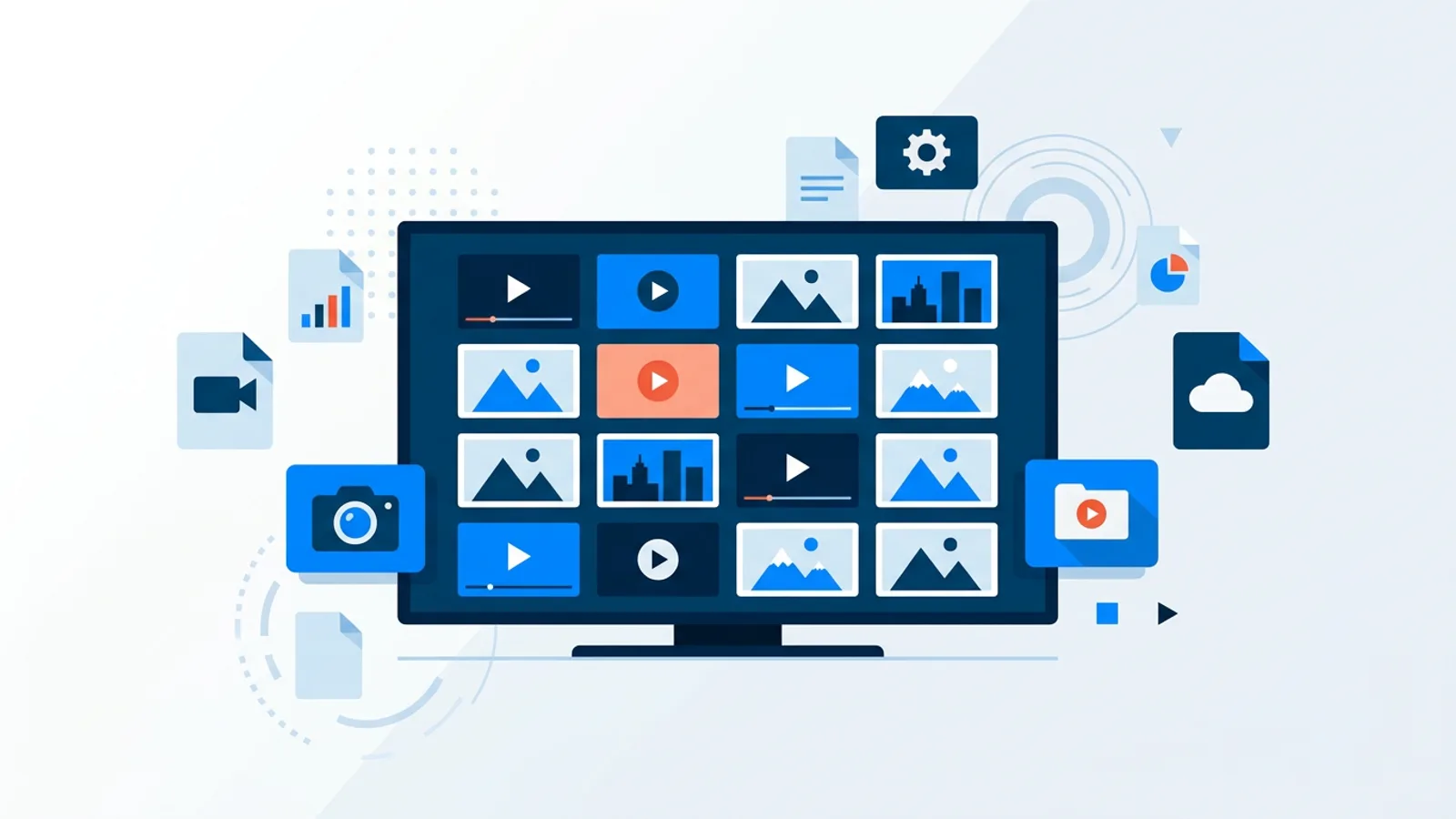
If you want a video to play the same way on every screen you own, save it as an MP4 file with H.264 video and AAC audio. That combination decodes on almost anything: an old Android TV box, a browser tab on a lobby smart TV, or digital signage running on a Raspberry Pi. Get the digital signage video formats wrong and a playlist that looked fine on your laptop will stutter, drop frames, or refuse to play at all once it hits a real screen in a real shop.
Most of the pain in signage playlists has nothing to do with the software managing them. It comes from files that were never meant for a TV: a 4K ProRes export from a video editor, a 40 MB PNG screenshot, a vertical phone video stretched across a landscape screen. Fix the files and the rest tends to sort itself out.
Video: container, codec and why the difference matters
A video file is really two things stacked together: a container (the wrapper, like .mp4 or .mov) and a codec (how the picture data is actually compressed, like H.264 or H.265). People say "format" and mean either one, which is where confusion starts.
For signage, the safest pairing is:
- Container: MP4
- Video codec: H.264 (also called AVC)
- Audio codec: AAC
H.264 has been the default for over a decade and every media player, browser and TV chip has dedicated hardware to decode it without breaking a sweat. H.265 (HEVC) compresses better at the same quality, so files are smaller, but hardware decoding support is patchier on older Android TV sticks, budget smart TVs and lower-end single-board computers. Unless storage space is genuinely tight, H.264 is the format that causes fewer support tickets.
Avoid ProRes, DNxHD, uncompressed AVI, or anything exported straight out of a professional editing timeline. Those are intermediate formats meant for editing, not for playback devices, and they are enormous for what they deliver on screen.
Resolution, frame rate and bitrate that actually matter
Most signage screens are 1080p (1920x1080) or occasionally 4K. There is rarely a reason to upload video larger than the screen it plays on: a 4K clip on a 1080p TV just burns storage and decoding effort for no visible benefit.
A sensible export for a landscape 1080p sign:
- Resolution: 1920x1080
- Frame rate: 25 or 30 fps (30 is fine for most promotional content; 24 fps film footage plays fine too)
- Bitrate: roughly 6-10 Mbps for H.264 at 1080p, video-on-demand quality
- Audio: AAC, 128-192 kbps if the clip needs sound
On a Raspberry Pi, decoding load matters more than on a powerful smart TV. A Pi 4 or 5 handles 1080p H.264 comfortably; pushing 4K H.265 footage onto older hardware is where you start seeing dropped frames or a player that falls behind on a busy playlist. If you are deciding between Pi models for a video-heavy playlist, the Pi 4 vs Pi 5 comparison is worth reading before you buy hardware.
Image formats and image size for TV screens
Images are simpler than video but people still get the sizing wrong constantly. The rules:
- JPG for photos and anything with gradients or lots of colour. It compresses well and files stay small.
- PNG for logos, text graphics, or anything that needs a transparent background. PNG files are bigger than JPGs at the same dimensions, so don't use PNG for photographic content.
- Avoid TIFF and BMP. They're print-era formats with no compression, and a single BMP can be ten times the file size of an equivalent JPG for zero visible quality gain on a TV.
For image size for TV screens, match the pixel dimensions to the screen, not to print resolution. A 1920x1080 JPG is plenty for a full-screen slide on a 1080p landscape TV; there is no "dpi" that matters here because a TV renders pixels, not dots per inch. For a portrait screen, flip that to 1080x1920. If you're running a rotated display, the portrait signage rotation guide covers the physical and software side of that setup.
A photo straight off a modern phone camera is often 4000+ pixels wide and several megabytes. That's not wrong, exactly, just unnecessary: resizing to roughly 1920 pixels on the long edge before upload keeps playlists loading fast and keeps a lot more slides inside a storage plan's limit.
A quick compatibility reference
| Media type | Recommended format | Why |
|---|---|---|
| Video | MP4 (H.264 + AAC) | Universal hardware decoding, small enough files |
| Video (storage-constrained) | MP4 (H.265) | Smaller files, but check playback on older hardware first |
| Photo / promo image | JPG | Small files, good enough quality for a TV at viewing distance |
| Logo / graphic with transparency | PNG | Keeps sharp edges and transparent backgrounds |
| Avoid | ProRes, AVI, BMP, TIFF | Editing or print formats, far too large for signage |
Where compatibility actually breaks down
The format itself is only half the story; the player matters too. A browser-based player (a smart TV's built-in browser, a laptop, most Android TV boxes) relies on whatever video codecs that browser's engine supports, which is usually H.264 plus H.265 on newer devices. A Raspberry Pi running a signage installer uses Chromium in kiosk mode, so the same rule applies: stick to H.264 and you're not gambling on codec support.
If you'd rather not manage local video files at all, pointing a playlist slide at a YouTube or Vimeo link sidesteps the format question entirely, since the video plays through the platform's own player rather than a file you uploaded. On a Raspberry Pi player, YouTube's "auto" quality setting caps at 720p specifically so the Pi decodes smoothly rather than choking on 1080p or 4K streams it wasn't asked to handle. It's a reasonable middle ground for owners who already have marketing video living on YouTube and don't want to re-export files every time something changes.
PDFs and web pages sidestep the video/image question altogether, since they're rendered rather than decoded frame by frame, which is why menu boards and price lists often work better as a designed slide than as an exported image screenshot.
Storage limits and why file size still matters
Even with the right format, file size adds up across a playlist. If you're on a plan with a smaller storage allowance, a handful of oversized, unoptimized video files will fill it fast, long before you've built out a real content rotation. Resizing and re-encoding files properly before upload isn't just a performance habit, it's what lets a modest storage plan hold an entire week's worth of playlist content instead of three clips.
Bandwidth also comes into play once a player is pulling updated content regularly across multiple screens; the bandwidth requirements guide goes into what that looks like across a multi-screen setup.
When TVpilot is the right fit, and when it isn't
TVpilot's playlists handle images, videos, web pages and PDFs, with drag-and-drop ordering, transitions, per-video mute and per-slide scheduling, so once your files are in a sane format, building the actual rotation is straightforward. If you're running signage on a Raspberry Pi, the one-command installer sets up Chromium kiosk mode with a watchdog that restarts playback automatically if something crashes, which matters more than people expect once a screen is unattended for weeks.
Where it's not the right fit: TVpilot is hosted software, not something you self-host or run without an internet connection for updates (the Pi player recovers on its own once connectivity returns, but it still needs that connection to fetch new content). If your setup genuinely requires a fully offline, air-gapped screen with no network dependency at all, a self-hosted alternative is a better match, and it's worth reading honestly about what that route costs in maintenance time before committing to it.
Getting your media into the right format before you build a playlist saves far more troubleshooting time than any setting inside the signage software itself. Once your files are sensible sizes in MP4 and JPG, sign up for a free TVpilot account and build the actual playlist, it takes a few minutes once the media itself isn't fighting you.
Frequently asked questions
What is the best file format for digital signage video?
MP4 with H.264 video and AAC audio is the safest default. It decodes on hardware-accelerated chips in nearly every TV, browser, Android TV box and Raspberry Pi, so you avoid stutter or playback failures caused by a device not supporting a less common codec like H.265 or an editing format like ProRes.
What image size should I use for a TV screen?
Match the pixel dimensions to the screen, not to print resolution. For a standard 1080p landscape TV, export images at 1920x1080. For a portrait screen, use 1080x1920. There's no meaningful "dpi" setting for screens since TVs render pixels directly, unlike print.
Can I just upload a video straight from my phone to a signage playlist?
Usually yes, since most phones already record in H.264 or H.265 MP4, but check the resolution and file size first. A phone shooting 4K at a high bitrate will be far larger than needed for a 1080p sign, and re-encoding it down to 1080p before upload keeps playlists loading faster and uses less storage.
Why does the same video play smoothly on one screen but stutter on another?
It's almost always a hardware decoding limit, not the file being broken. Lower-powered devices, including older Android TV sticks or an original Raspberry Pi model, can struggle with high-bitrate 4K or H.265 footage that a newer TV chip or a Pi 4/5 handles without issue. Re-exporting at 1080p with H.264 usually resolves it.