Digital Signage Player Alternatives to a Media Box
A dedicated digital signage media player is a small box that runs one job: play a loop of content on a screen. If you're looking at digital signage player alternatives, the short answer is that a browser, a Raspberry Pi, or the smart TV you already own can do the same job for less money and, in some cases, less hassle than a proprietary box tied to one vendor's software.
This matters because the "media player" line item is often the most overpriced part of a signage quote. Vendors bundle a locked-down Android box with their software subscription and charge accordingly. Once you understand what the box actually does, you can replace it with hardware you buy yourself, or skip it entirely.
What a dedicated media player actually does
A signage media player is a small computer that:
- Boots straight into a full-screen browser or app, with no desktop, taskbar, or icons visible
- Connects to a content management dashboard over the internet or local network
- Downloads or streams the assigned playlist and loops it
- Restarts itself if the app crashes or the network drops
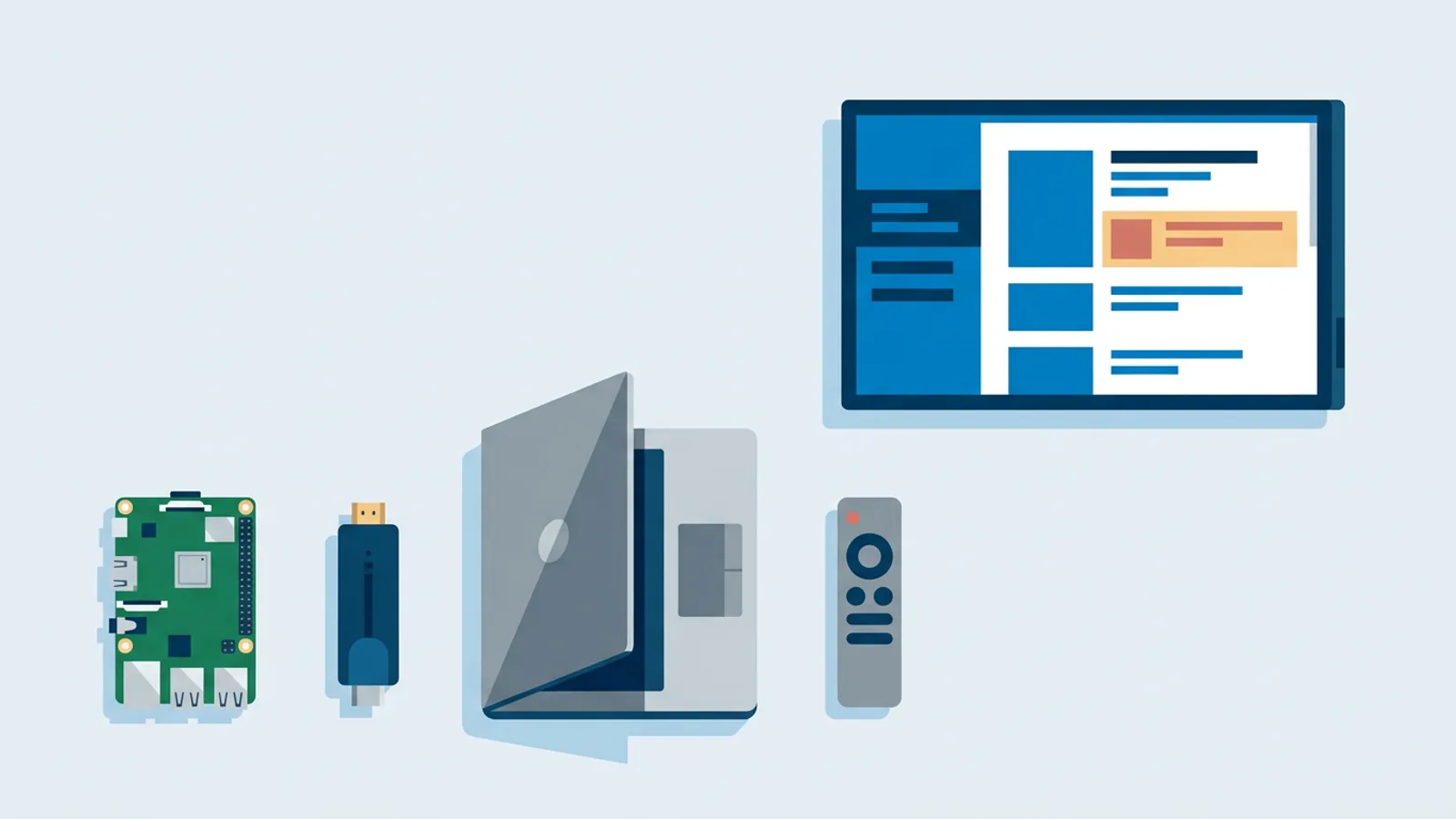
None of that requires proprietary hardware. That's why a Raspberry Pi, priced roughly in the $35-80 range depending on the model, a budget streaming stick typically under $50, or the TV's own built-in browser can often do the same job as a dedicated commercial player that usually costs several times more.
Our guide to running signage on a Raspberry Pi covers the setup in detail if that's the route you're considering. It takes one command and a few minutes.
Alternative 1: use the browser you already have
Every modern TV, laptop, and streaming stick ships with a browser, even if it's buried in the settings menu. If your content is a web page, a slideshow, or a dashboard, you don't need an app at all. Point the browser at a URL and set it to full screen.
The practical hurdles are keeping the browser from sleeping, hiding the cursor and address bar, and getting it to reload automatically if the screen loses power overnight. Chromium's kiosk mode handles most of this with a couple of launch flags; our Chromium kiosk mode guide walks through the flags and what each one does. This is the mechanism behind most signage without a media player, including TVpilot's browser-only players.
Alternative 2: Raspberry Pi
A Raspberry Pi running Raspberry Pi OS with a desktop is the closest thing to a purpose-built signage player without buying one. It's inexpensive, well documented, and not locked to any single software vendor.
With TVpilot, setup is a single command generated in the dashboard along with a 6-character claim code: you paste it into the Pi's terminal and it installs Chromium in kiosk mode, sets up auto-start on X11 or Wayland with a systemd service, and adds a watchdog that restarts the player within about 10 seconds if anything goes wrong. The Pi also checks the power schedule every minute and switches the TV on or to standby over HDMI-CEC, so a screen can turn itself off overnight without a smart plug. Any Pi with a desktop works; a Pi 4 or 5 is worth the extra cost if you're playing video rather than static images.
The Raspberry Pi hardware list and the 15-minute tutorial cover exactly what to buy and how the first boot goes.
Alternative 3: Fire TV Stick, Android TV, or the smart TV itself
If you already have a smart TV or a streaming stick plugged into one, that's your media player. Fire TV Sticks and Android TV devices both run a browser app that can be set to kiosk mode, and most modern smart TVs (Samsung, LG, and others) have a browser hidden in their app store or settings.
The tradeoff is consistency. Every TV brand handles auto-restart, screen timeout, and browser updates differently, and some smart TV browsers are slow or drop features like video autoplay. Our breakdowns of Fire TV Stick kiosk mode, Android TV signage, and running a browser on a smart TV go through the quirks for each. If you're weighing the Amazon Signage Stick specifically, there's a separate explainer on what signage.amazon.com offers.
Alternative 4: an old laptop
If a laptop is gathering dust in a closet, it can run signage too: closed-lid mode disabled, browser set to full screen, power settings changed so it never sleeps. It draws more power than a Pi, but it costs nothing and works today. This is a fine short-term bridge while you decide on permanent hardware, and it's covered as one option in the spare TV to live screen guide.
Digital signage player alternatives compared
| Option | Relative cost | Setup effort | Best for |
|---|---|---|---|
| Browser on existing smart TV | None, uses hardware you own | Low, but browser quality varies | Testing, single screens, simple content |
| Fire TV Stick / Android TV | Low | Low-medium | Renting a screen you don't control, quick installs |
| Raspberry Pi | Low-medium, one-time | Medium (one-time setup) | Long-term, multiple screens, reliable auto-restart and TV power scheduling |
| Old laptop | None, uses hardware you own | Low, but bulky and power-hungry | Temporary or one-off displays |
| Dedicated commercial player | Highest, vendor-set | Low, but locked to one vendor | Rarely worth it unless bundled with support you need |
None of these are wrong choices on their own. A dedicated player still makes sense for large installs where a vendor handles procurement and support as one package, which is closer to the managed-service model covered in digital signage as a managed service. For everyone else, the software running on the screen matters more than the box underneath it.
When TVpilot fits, and when it doesn't
TVpilot is signage software, not a piece of hardware, so it works across all the alternatives above: Raspberry Pi with the one-command installer, or any device with a modern browser pointed at a player URL. Playlists, per-slide scheduling, calendar scheduling, and the design tools in the dashboard work the same regardless of which box the screen is plugged into.
It's a good fit if you want to avoid buying proprietary hardware, manage more than one screen from a single dashboard, or need scheduling and design features beyond a static web page on a loop. The Free plan covers one screen with 250 MB storage and no credit card required, which is enough to try the browser or Pi route before deciding whether to pay for more screens.
It's not the right fit if you need a fully offline system with no internet dependency (players need a connection to receive content updates, though the Pi player recovers automatically after an outage), or if you specifically want open-source, self-hosted software you run on your own server. TVpilot is hosted SaaS, not self-hostable. If self-hosting is a requirement, the self-hosted digital signage checklist and open source signage cost breakdown are worth reading first.
Getting started without buying a media player
The cheapest path is usually: pick a browser-capable device you already own or can buy for typically under $100, install a kiosk-mode browser or a one-command signage player on it, and connect it to a dashboard that handles scheduling and content so you're not editing HTML by hand. Whether that device is a Raspberry Pi, a Fire TV Stick, or the smart TV bolted to the wall already, the software layer is what turns a screen into signage rather than the box plugged into the back of it.
If you want to try this without committing to hardware first, create a free TVpilot account and set up a browser-based player against any screen you have in front of you right now.
Frequently asked questions
Do I need special hardware for digital signage, or can I just use a browser?
For most content, no special hardware is required. If what you want to show is a web page, image slideshow, or dashboard, a browser in full-screen kiosk mode on a TV, laptop, or streaming stick can do the job. You only need extra hardware if the built-in browser on your device is missing, unreliable, or too slow for video.
Is a Raspberry Pi reliable enough to replace a commercial signage player?
Yes, for most small business use. Raspberry Pi OS with a desktop can run a browser in kiosk mode continuously, and adding a watchdog service that restarts the browser after a crash or network drop closes most of the reliability gap with a purpose-built box. TVpilot's Pi installer sets this up automatically, including a watchdog that restarts the player within about 10 seconds.
Can a Fire TV Stick or smart TV run digital signage without extra hardware?
Yes, if the device has a usable browser. Fire TV Sticks and Android TV devices can run a browser app in kiosk mode, and many smart TVs have a hidden browser in their settings or app store. Browser quality and auto-restart behavior vary by brand, so test the specific device before relying on it for unattended signage.
When does a dedicated commercial media player still make sense?
It can make sense for larger rollouts where a vendor handles hardware procurement, shipping, and support as a single package, similar to a managed-service arrangement. For a handful of screens that one person manages, a browser, Raspberry Pi, or existing smart TV usually covers the same functionality without the vendor lock-in.