Fix HDMI-CEC Not Working on Digital Signage TVs
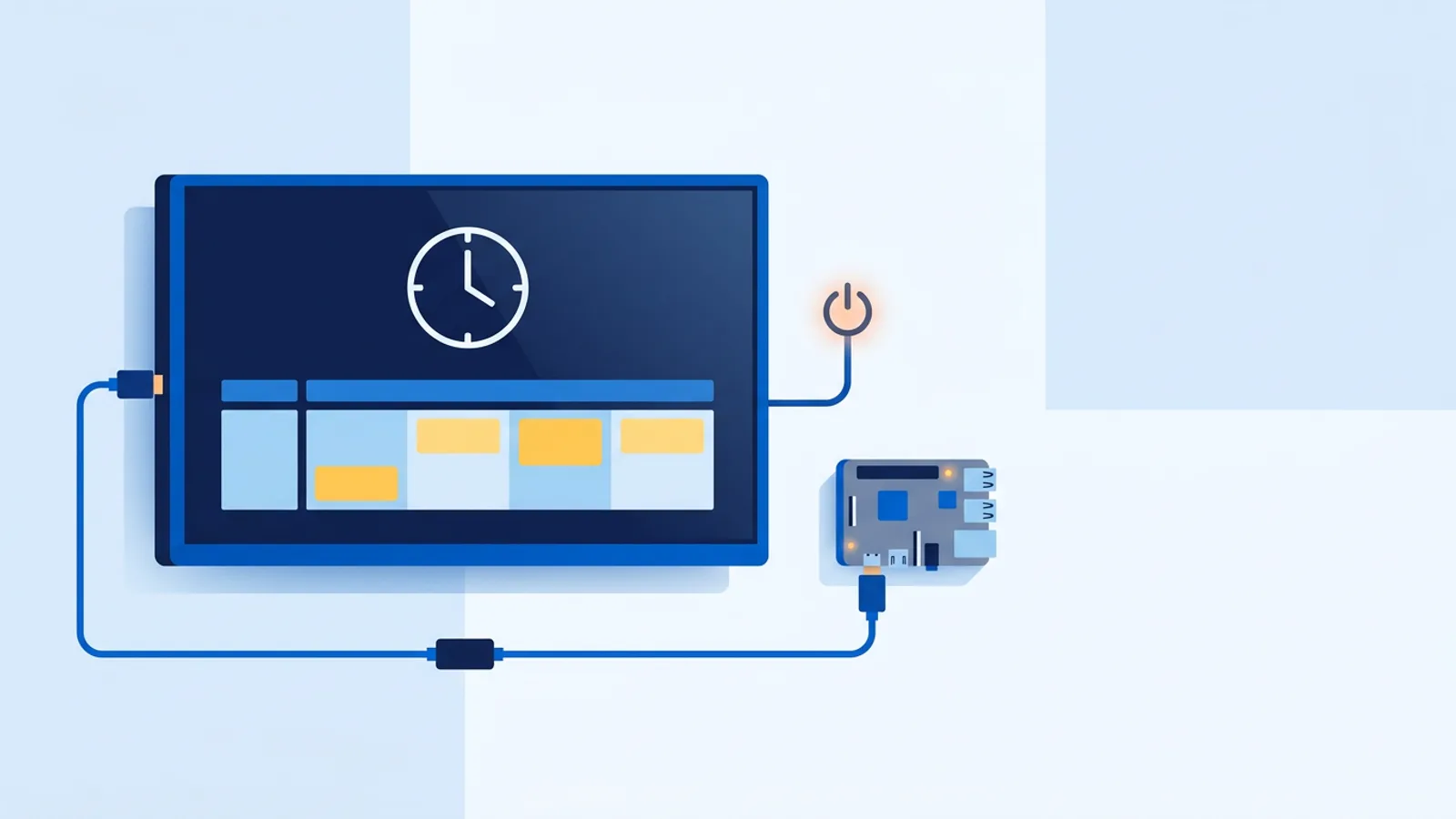
You scheduled your signage screen to turn off at night and it just... doesn't. Or it turns off fine but never wakes back up in the morning. Nine times out of ten this is HDMI-CEC not working on your digital signage screen the way the software expects, and the fix is usually a TV settings menu, not new hardware.
HDMI-CEC (Consumer Electronics Control) is the feature that lets one HDMI device send power and control signals to another over the same cable that carries video. Signage players use it to switch the TV on at opening time and put it into standby after closing, without a smart plug or a separate IR blaster. It's a neat trick when it works. It's also one of the least standardized features in consumer electronics, which is why it's the single most common thing signage installers get support tickets about.
If you're setting this up on a Raspberry Pi, the good news is the Pi's CEC implementation is solid and well documented. The bad news is your TV's CEC implementation might not be. Here's why, and how to fix it.
Why HDMI-CEC fails on digital signage displays
CEC is part of the HDMI spec, but manufacturers implement it under their own brand names, with their own quirks, and sometimes with bugs that never get fixed because so few people use the feature. Samsung calls it Anynet+, Sony calls it Bravia Sync, LG calls it SimpLink, Panasonic calls it Viera Link. They're all doing roughly the same job, but the menu you need to find, the default state (on or off), and how strictly the TV follows the spec all differ.
On top of that, CEC signals travel over the same physical pins as the video connection, so a cheap cable, a bad port, or an HDMI switch/splitter in the chain can silently eat the command before it reaches the TV. The video still works fine, which is why this is confusing: everything looks connected, but the power command never arrives.
Quick checklist before you dig deeper
Run through these first. They resolve the majority of "CEC not working" cases in under five minutes:
- CEC is enabled in the TV's settings menu (see brand names below), not just assumed to be on by default.
- The signage player is plugged into the exact HDMI port the TV's CEC menu references. Some TVs only support CEC on one specific port (often HDMI 1 or the port labelled ARC).
- You're using a real HDMI cable rated for your resolution, not a video-only or overly long passive cable that drops the CEC pin.
- There's no HDMI switch, splitter, extender, or AV receiver sitting between the player and the TV. Each of those has to actively pass CEC through, and cheap ones often don't.
- The TV has been power-cycled (unplugged from the wall for 30 seconds) after enabling CEC. Some TVs only apply the setting after a full restart.
Find the CEC setting by brand
The menu name and location changes every year even within one brand, but this table gets you close:
| Brand | CEC feature name | Usually found under |
|---|---|---|
| Samsung | Anynet+ (HDMI-CEC) | Settings > General > External Device Manager |
| Sony | Bravia Sync / Control for HDMI | Settings > External Inputs |
| LG | SimpLink | Settings > General > Devices > HDMI Devices |
| Panasonic | HDAVI Control / Viera Link | Settings > System Menu > HDMI Control |
| Philips | EasyLink | Settings > Eco Settings or General Settings |
| TCL / Hisense (Android TV/Google TV) | HDMI-CEC or Device Auto Power | Settings > System > Inputs, or Device Preferences |
If your TV doesn't appear here, search the model number plus "HDMI CEC" rather than the brand name generically. Firmware versions move the setting around often enough that a screenshot from three years ago won't match your menu today.
Multiple CEC devices arguing over control
If you've also got a soundbar, AV receiver, or game console plugged in via HDMI, they're all CEC devices too, and CEC lets any of them claim the "active source" role. A soundbar that wakes up and grabs control can override the standby command your signage player just sent, or wake the TV back up seconds after it went to sleep. If your screen is turning on and off unpredictably rather than just not responding at all, disconnect other CEC devices one at a time to find the culprit, or disable CEC on everything except the signage player if your TV allows per-device control.
Checking CEC from the player side
On a Raspberry Pi running signage software, CEC commands go out over the same HDMI cable to the display. If the TV never receives them, that's almost always a TV-side or cable-side issue rather than the Pi's. A useful sanity check: unplug and replug the HDMI cable at both ends (a loose connection is a surprisingly common cause), then try a different cable if you have one, ideally a shorter, well-shielded one.
If you're chasing broader Pi player issues, not just CEC, the Raspberry Pi signage troubleshooting guide covers boot, display and network problems separately, which helps rule out whether the power issue is really CEC or something else entirely (like the player crashing and the TV going to sleep on its own after a few minutes with no signal).
When to stop fighting CEC and use a smart plug
Some TVs, especially budget models and older sets, have CEC implementations that are technically present but unreliable in practice: they'll accept the "on" command from the same source nine times and ignore it the tenth, or need the remote pressed once before they'll respond to anything. If you've worked through every item above and CEC still misbehaves on a specific model, it's fine to route around it. A CEC-controllable outcome and a smart-plug-controlled outcome are both valid ways to cut power overnight; see our guide to turning off signage at night for the tradeoffs of each approach, including the difference between putting the TV in standby (screen off, TV still drawing a little power, wakes up faster) versus cutting power at the plug entirely.
Where TVpilot fits, honestly
On TVpilot's Raspberry Pi player, the power schedule you set in the dashboard is checked every minute, and the player sends the CEC on/standby command to the TV automatically, no smart plug required. That's genuinely convenient when your TV's CEC implementation cooperates, and most mid-range and recent TVs from the brands in the table above do.
Where it isn't the right fit: if you're on a browser-based player (a smart TV's own browser, Fire TV Stick, or similar) rather than a Raspberry Pi, TVpilot doesn't send CEC commands from those, because the browser sandbox doesn't expose that level of hardware control. In that case, use the TV's own built-in sleep timer, or a scheduled smart plug, alongside your content schedule. And if your specific TV model has a flaky CEC stack no matter what you try, a smart plug on a timer is a perfectly reasonable, boring solution that just works. There's no ranking or reward for insisting on CEC when a €10 plug solves the problem faster.
Testing your fix
Once you've made a change, don't just wait for the next scheduled on/off event to see if it worked. Most signage dashboards, including TVpilot's, let you push a state or a playlist manually so you can confirm the TV responds within a minute rather than finding out at 6am that it didn't. Test the "on" command and the "standby" command separately: it's common for one direction to work and the other not to, especially waking a TV from standby, which some models only accept from their own remote and not from CEC at all.
If everything checks out on the TV side but the schedule itself still seems to fire at the wrong time, that's a separate problem worth checking in your scheduling settings rather than in CEC.
If you're setting up a Pi-based screen, sign up for TVpilot and run the schedule against your own TV this afternoon: most CEC issues show up within the first couple of scheduled on/off cycles. The free plan covers one screen with no credit card required, so you can confirm your TV cooperates before adding more screens.
Frequently asked questions
Why won't my TV turn on with CEC even though it turns off fine?
Waking a TV from standby is a stricter operation than putting it to sleep, and some TV models only accept a wake command from their own remote's power button, not from another CEC device. Check the TV's CEC menu for a separate "power on" or "wake" toggle (some brands ship this disabled even when general CEC is on), and confirm the TV is on the exact HDMI port its CEC menu references. If the setting is correct and it still won't wake, that TV's CEC implementation is one of the ones that just doesn't support remote wake reliably, and a smart plug is the simpler fix.
How do I troubleshoot HDMI-CEC step by step?
Start with the cable and connection: reseat the HDMI cable at both ends and rule out any switch, splitter, or AV receiver between the player and TV, since those often block CEC even though video still works. Then confirm CEC is enabled in the TV's menu under its brand name (Anynet+, Bravia Sync, SimpLink, etc.), on the correct HDMI port, and power-cycle the TV after changing the setting. Finally, disconnect other HDMI devices like soundbars one at a time, since they can compete for control and override commands from your signage player.
Why does my scheduled TV power on/off not work even though the schedule looks correct in the dashboard?
If the schedule itself is correct in the software, the problem is almost always downstream: the TV isn't actually receiving the CEC command. Work through the CEC checklist first (cable, port, no switch in the chain, CEC enabled and power-cycled) before assuming the schedule is wrong. If the schedule still fires at the wrong time after CEC is confirmed working, that points to a scheduling configuration issue rather than a power issue, worth checking separately.
Do I need a smart plug if HDMI-CEC doesn't work on my TV?
Not necessarily, but it's a reasonable fallback. If you've worked through the full CEC checklist (correct port, good cable, no switch in the chain, CEC enabled and power-cycled, no competing CEC devices) and the TV still won't respond reliably, a smart plug on a timer is a simple, working alternative. The tradeoff is that cutting power at the plug is a harder off than standby: the TV loses its clock and settings memory on some models, and takes a little longer to come back on.