Digital Signage for Gyms: Classes, Promos and Motivation
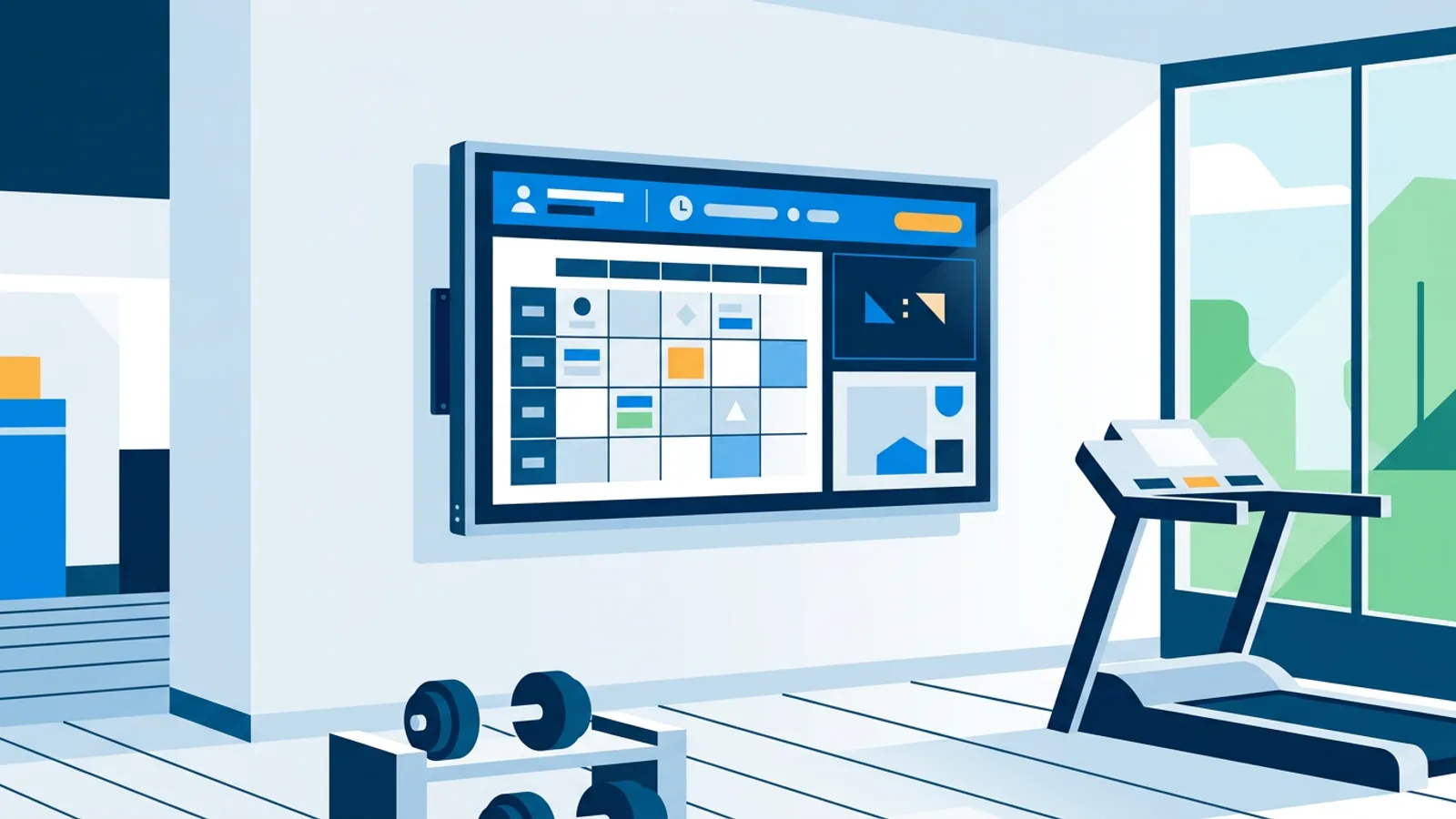
If you run a gym or studio, the TV on the wall is either turned off or stuck on a cable news channel nobody watches while lifting. Digital signage for gyms replaces that with a screen that actually earns its spot on the wall: the day's class lineup, a promo for the next challenge, member reviews, and a countdown to the 6pm spin class, all updated from a laptop instead of a laminator and a roll of tape.
Most gyms already own the hardware for this. The TV is bolted up. What's missing is software that can push a schedule, a promo and a motivational slide to that screen without someone walking over with a USB stick every Monday. A dashboard controls the screen remotely instead, so the front desk stops being an unpaid graphic designer.
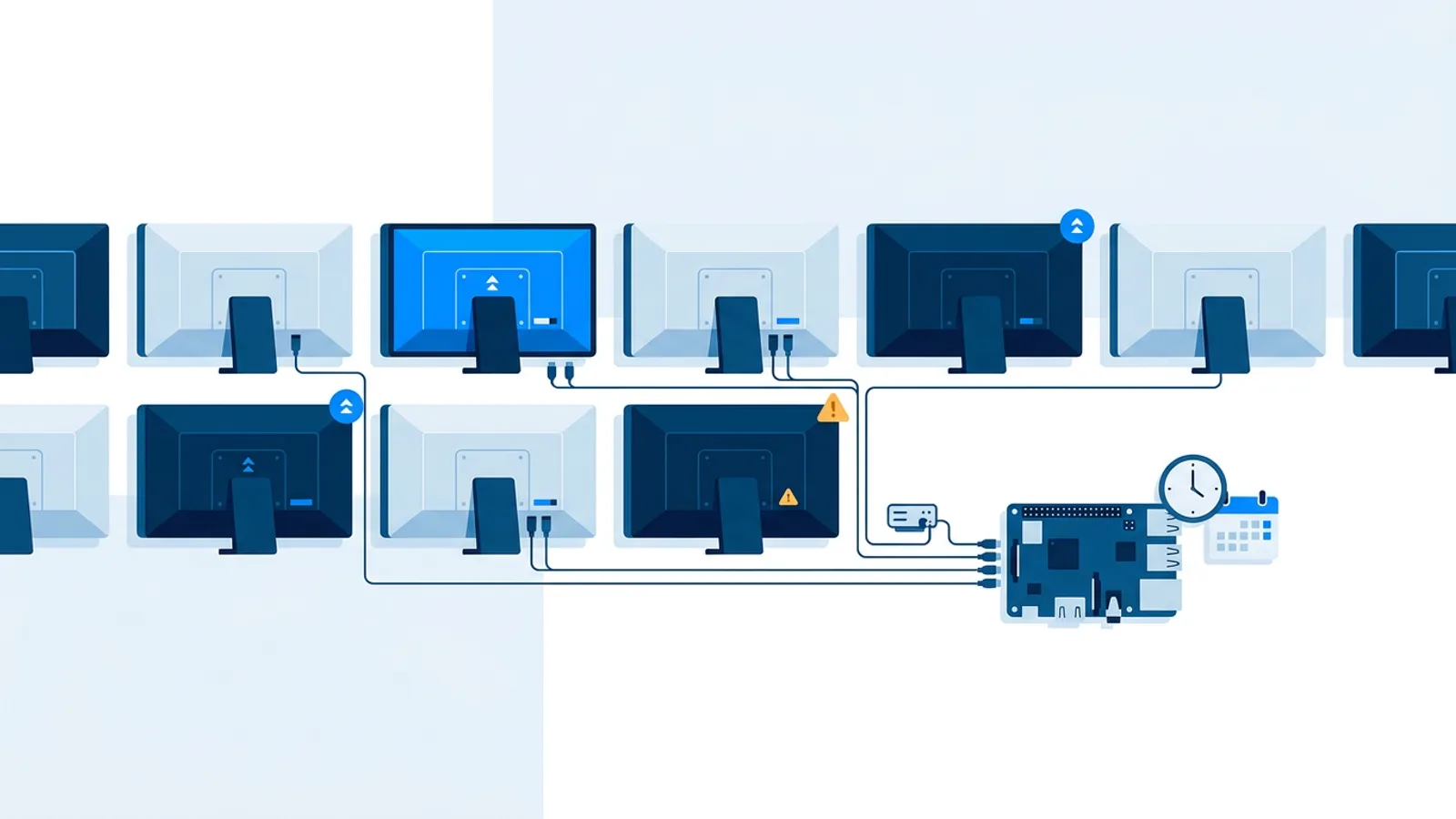
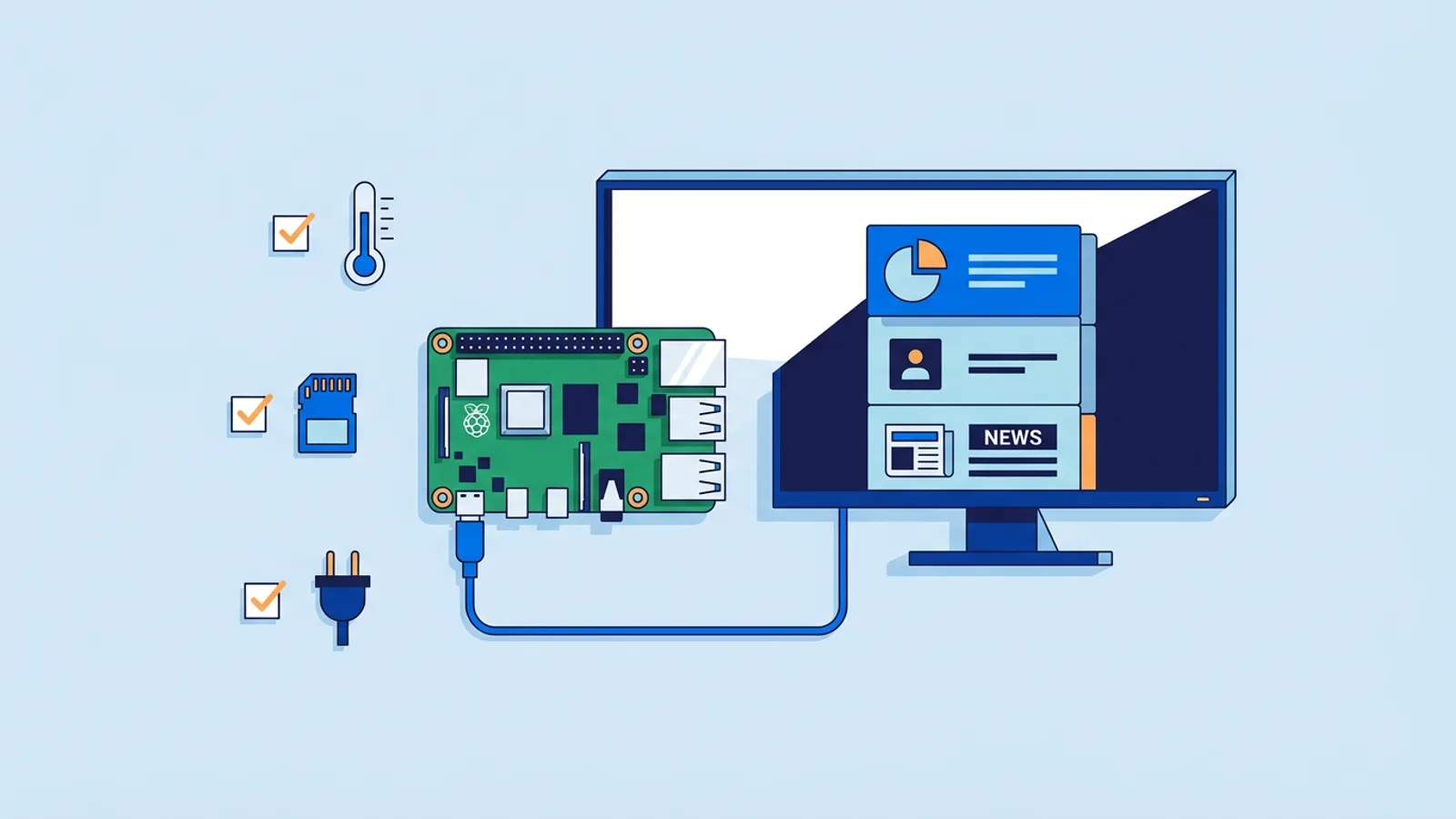
On the hardware side, a cheap Raspberry Pi player is the most common way gyms do this cheaply: plug it into the back of the TV, run one setup command, and it becomes a dedicated sign that boots straight into kiosk mode and stays that way. No monthly media-player rental, no proprietary box.
Digital signage for gyms: what actually earns screen time
A gym screen has one job: give members a reason to look up from their phone between sets. That means the content has to change often enough to be worth a second glance, but not so often it looks chaotic. The gyms that get this right usually run three or four rotating slide types rather than one static poster:
- The current class schedule, filtered to what's happening in the next few hours
- One promo (a challenge, a referral bonus, a new class launch)
- Social proof (reviews, an Instagram wall of member posts)
- Something purely motivational or informational (a quote, the weather, a countdown)
The schedule slide does the heavy lifting. Everything else exists to give the screen personality so it doesn't read like an ad board.
Class schedule screen ideas that update themselves
A class schedule screen only works if nobody has to remember to update it. TVpilot's calendar scheduling handles this by letting you assign a playlist to a screen through a calendar rather than manually swapping slides: set a weekly repeating slot for "morning classes" from 6:00 to 11:00, another for "evening classes" from 16:00 to 21:00, and a one-off override for a holiday class schedule or a special event day. One-off items always beat the weekly pattern, so a Saturday bootcamp doesn't get quietly overwritten by the regular Tuesday slot.
For finer control, individual slides can be daypart-scheduled on their own: a "Spin, 6pm, Studio 2" slide can be set to appear only Monday, Wednesday and Friday between 5:30 and 6:15, then disappear on its own without anyone touching the playlist. If an instructor cancels last minute, "Show now" pushes a replacement slide to the screen for the next hour, or until you manually clear it, and the screen returns to its normal schedule automatically afterward.
If the connection to the dashboard drops for a few minutes, or the class calendar is genuinely empty for a stretch, a backup playlist keeps something reasonable playing instead of a black screen, which matters more in a gym than almost anywhere else, since a blank TV next to the free weights reads as "this place is falling apart."
Free accounts get 1 calendar and 2 scheduled items, enough for a single small studio with a simple weekly rhythm. Starter (5 screens) bumps that to 5 calendars and 20 items; Pro and Business go up to 25 calendars and 200 items, which is closer to what a multi-room facility with several class formats actually needs. More on the scheduling mechanics is in the scheduling guide.
Gym TV display ideas beyond the schedule
Once the schedule slide is handled, the rest of the rotation is where a gym screen either feels alive or feels like an ad kiosk. A few ideas that hold up over months, not just the first week:
| Content type | What it does | TVpilot feature |
|---|---|---|
| Live countdown | Builds anticipation for a challenge launch, a new class, or a sale end date | Countdown timer widget (flip, digital or minimal style) |
| Member social wall | Shows recent tagged posts and photos as a live feed | Instagram social feed widget |
| Trust signals | Rotates recent reviews and an overall score for new visitors at the desk | Google reviews or Trustpilot widget |
| Weather | Useful for outdoor bootcamps, run clubs, or cycling groups deciding on the day | Weather widget |
| Promo of the week | A designed slide for a referral bonus, merch drop, or seasonal offer | Designer or AI Studio |
The countdown widget is worth calling out specifically for gyms: beyond counting down to an event date, it can be set to count to the same time every day, which makes it usable as an actual interval timer for a HIIT class or a closing-time countdown at the front desk, with an optional red warning state in the final minutes.
For the promo slide, AI Studio generates a designed screen from a short written brief, which is useful when nobody on staff has design skills and the sale starts tomorrow. If you'd rather build it by hand, the built-in Designer has templates, shapes, logo placement and QR codes. More general ideas (not gym-specific) are in the content ideas guide.
Fitness studio signage across multiple locations
A single studio can run everything above from one login. A small chain with three or four locations manages every screen from the same TVpilot account, with each screen keeping its own playlist and calendar so a room-specific class time at one site doesn't have to match another. Pro (up to 25 screens) and Business (25 or more, custom pricing) plans have room for a multi-site rollout, and their shared calendar limit, 25 calendars and 200 scheduled items, covers several independent class schedules without hitting a wall. Blackout dates, including Dutch holiday presets, mean a chain-wide closure doesn't need to be scheduled by hand at every site. The setup pattern for this is covered in more depth in the multi-location setup guide.
Hardware: what to actually put behind the screen
Most gyms already have the TV. What's missing is a small player behind it. A Raspberry Pi 4 or 5 running Raspberry Pi OS is the cheapest reliable option: a one-command installer sets up Chromium in kiosk mode, a watchdog that restarts the player within about 10 seconds if it crashes, and a systemd service so it survives reboots without anyone touching it. It also handles HDMI-CEC power scheduling, so the TV switches on before opening time and goes to standby after closing without a separate smart plug. Full parts and setup steps are in the Raspberry Pi hardware list.
If a gym already has a modern smart TV or a Fire TV Stick lying around, the browser route works too: point the built-in browser or a Fire TV browser app at the player URL and it runs the same playlists, just without the CEC power scheduling a Pi gets by default.
When TVpilot fits a gym, and when it doesn't
TVpilot is a good fit for a gym or studio that wants a schedule screen, a promo rotation, and reviews running without hiring anyone to manage it, and that's fine relying on an internet connection for updates (the Pi player recovers on its own after an outage, but it isn't built for a fully offline site). It's hosted software, not something you self-host on your own server, so if a gym specifically wants full server control or an open-source stack, a self-hosted setup is worth comparing instead.
It's a weaker fit if the gym needs a dedicated native Android TV or Fire TV app rather than a browser-based player, since that route isn't available yet, only the browser workaround. For everything else, a single studio, a boutique chain, or a big-box gym with a dozen screens, the feature set (calendar scheduling, per-slide dayparting, reviews, social feeds, countdowns) covers what a gym wall actually needs.
A gym screen doesn't need to be complicated: a schedule that updates itself, one promo, and something that makes members feel like the place is alive. Start on the Free plan (one screen, 250 MB storage, no card required) at tvpilot.app/signup and put a real class schedule on the wall this week.
Frequently asked questions
What's the cheapest way to set up a class schedule screen for a small gym?
A Raspberry Pi 4 or 5 with an HDMI cable is the cheapest reliable option: run TVpilot's one-command installer, which sets up Chromium kiosk mode and a watchdog that restarts the player automatically if it crashes. Combined with the Free plan (one screen, 250 MB storage, no card required), a single-room studio can get a working schedule screen for the cost of the Pi itself.
Can the screen automatically switch between morning and evening class schedules?
Yes. Calendar scheduling lets you assign a weekly repeating time slot to a playlist, so a morning-classes playlist can run 6:00 to 11:00 and an evening-classes playlist can take over from 16:00 to 21:00 on the same screen, without anyone swapping content by hand.
What happens if an instructor cancels a class at the last minute?
Use "Show now" to push a replacement slide or playlist to the screen immediately for a set window (30 minutes, 1 hour, or until a chosen time). Once that window ends, the screen automatically returns to its normal calendar schedule.
Does TVpilot support Instagram feeds and reviews on the same screen as the class schedule?
Yes, both are separate widgets you can add to a playlist alongside the schedule slides: an Instagram social feed widget shows recent posts as a live wall, and Google or Trustpilot review widgets rotate recent ratings and comments.